Korean exfoliating mitts: how to use one properly
What an Italy towel actually does, how the viscose weave works, how often to use it by skin type, and the four mistakes that turn exfoliation into irritation.
Written by Tatuo. Guidance quoted from American Academy of Dermatology, read 19 August 2026.
What a Korean exfoliating mitt is
A Korean exfoliating mitt is a textured glove made to be used on wet skin in the bath, then rinsed and hung to dry. The texture is the point: the cloth carries a fine, slightly rough weave, usually viscose, that grips dead skin and lifts it off instead of smearing soap across it. Most mitts we sell measure around 8 by 5.5 inches, sized to fit an adult hand with a little cuff at the wrist so it does not slip mid-rub.
The format comes from Korean bathing culture, where body scrubbing is its own step rather than an afterthought of the shower. The mitt is paired with ordinary body cleanser or plain warm water. The work is done by the cloth, not by the product. In Italy, the same idea shows up as the "Italy towel," a coarser woven cloth used the same way. Two countries, same principle: a textured cloth does what a soft sponge and a bar of soap cannot.
What a sponge does not do is grab. A sponge's job is to hold lather and pad it against the skin. A mitt's job is to pull along the skin under light pressure, catching the loose layer as it goes. The difference shows up in the result: smoother-feeling skin after a single session, and a mitt that dries hard between uses rather than staying damp and soft the way a sponge does.
We package our Korean exfoliating mitts by the dozen because a mitt is the kind of thing a household replaces often. Twelve lets a family or a shared bathroom rotate one out without a special trip, and it keeps the cost per mitt under a dollar on most packs we carry.
Why viscose and not cotton
Viscose is the fiber we use for our exfoliating mitts, and the reason comes down to what the weave does when it gets wet. A dry viscose mitt feels soft and almost papery. Soak it, and the weave tightens into a slightly stiff, textured surface with a faint tooth to it. That stiffness is the working surface. It is what lets the mitt lift dead skin without you having to press hard.
A cotton washcloth does something different. Cotton fibers absorb water and swell, but the weave stays loose and the cloth stays floppy against the skin. You end up doing most of the work with your hands, and the cloth is mostly there to spread soap. Microfiber terry sits on the other side. Its fine synthetic loops grab the skin through sheer surface area, which is gentle and pleasant in a daily shower, but it does not have the abrasive pull of a stiffened viscose weave. Good for everyday washing, less useful when you want to clear a week of buildup in one pass.
Cotton flannel is the closest comparison. It is woven tighter than terry and looser than our viscose, and it softens further with every wash. After a dozen cycles, a flannel is doing very little mechanically. Viscose holds its texture across the life of the mitt, so we make ours from it.
| Fiber | Feel on wet skin | What it is good at | What it is bad at |
|---|---|---|---|
| Viscose (Italy towel weave) | Grippy, almost rough when damp | Lifting dead skin from legs, arms and back | Faces, and any skin that is already sore |
| Microfiber terry | Soft with a slight drag | Daily washing with mild lift | Heavy exfoliation; it will not do it |
| Cotton flannel | Soft, no drag | Sensitive skin and faces | Anything that needs grip |
Mitt or washcloth: the honest difference
A Korean exfoliating mitt is a slip-on glove with a textured weave. You wet it, wet your skin, and rub. The friction does the work. There is no soap in the mitt, and there is no soap needed. Our 12-pack is viscose, cut to 8 by 5.5 inches, which fits a hand without bunching at the fingers.
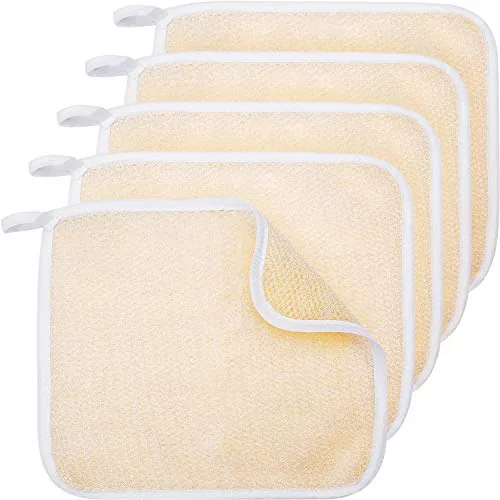
A washcloth is a softer tool. You lather it, you pass it over the skin, and the soap does most of the work. Our 5-pack is nylon, beige, and behaves more like a small towel than a scrubber. It is the kind of thing that lives by the bath and gets used every day.
So who each one suits comes down to how much friction a person wants against their skin, and how often. The mitt suits someone who wants a deeper exfoliation once or twice a week and has the skin to take it. The washcloth suits someone who wants a daily cleanse and a lighter touch, or whose skin reads every rough surface as a complaint. Both have a place. The question dermatologists tend to answer next is how hard, how often, and what to avoid doing with either one.
Those with dry, sensitive or acne-prone skin may prefer just a washcloth and a mild chemical exfoliator, as mechanical exfoliation may be too irritating for this skin type.
American Academy of Dermatology, How to safely exfoliate at home, read 19 August 2026
How to use one, step by step
Soak the skin first. The mitt works on wet, soft skin, so the cleanest setup is at the end of a warm shower, after a few minutes under the water. Dry skin and a dry mitt is the most common way to overdo it: the fabric grabs instead of gliding, and the natural response is to press harder.
Wet the mitt thoroughly and wring it out lightly so it stops dripping. The weave needs water in it to do its job. Once it is saturated, the texture of the mitt is what lifts the loose skin, not pressure from your hand.
Work in short strokes, going in one direction rather than scrubbing back and forth. Long, light passes from ankle upward cover the body faster and more evenly than small circles, and they keep you from going over the same patch repeatedly in one session. A few minutes is usually enough. The skin should look clean, not bright pink. If a patch turns red while you are still working, move on. Knees, heels and elbows take a slightly firmer pass than the rest of the body. Skip the face, broken skin, and any area shaved in the last twenty-four hours.
Rinse the skin with cool water, then rinse the mitt until the water runs clear. Squeeze it out and hang it somewhere that gets airflow so the weave dries between uses. We make ours in viscose, and they hold their texture as long as they are not stored damp. Our twelve-pack is built around the same idea: rotate through them so a clean, dry mitt is the one waiting by the shower.
How often, by skin type
Frequency is not a fixed number on the calendar. It depends on the skin and on what the skin is telling you after each session. The mitt works through friction, not chemistry, so the only signal that matters is how the skin looks and feels the next morning. A session that left the skin a soft pink for an hour is one thing. A session that left it red, tight, or stinging into the next day is another, and it is the second one that tells you to wait longer next time.
Oily areas of the body can usually take more frequent sessions than dry patches on the same person. The forearms, the back, and the soles of the feet are forgiving. The inner arms, the chest, and behind the knees are less so. Skin that is broken, freshly shaved, sunburned, or recovering from waxing is off-limits until it has settled, whatever the routine usually looks like. Fragrance, retinoids, and strong acids also change the math, since the skin barrier is already under pressure on those days.
The question we hear most from readers is the simplest one: how often. We have laid out the answer in the table below, with a starting point for each skin type. Treat the numbers as a starting point, not a rule, and adjust by what your own skin shows you. The follow-up question is usually about what to do on the days in between, which is where the next section picks up.
| Skin | Method | How often | First sign to stop |
|---|---|---|---|
| Dry or sensitive | Washcloth only | Once a week | Redness after the shower |
| Normal | Mitt, light pressure | Once or twice a week | Tightness the next morning |
| Oily or thicker | Mitt, full size | Twice a week | Stinging when moisturizer goes on |
| Acne-prone | Washcloth, and ask a dermatologist first | Once a week at most | Any new breakout after use |
Generally, the more aggressive the exfoliation, the less often it needs to be done.
American Academy of Dermatology, How to safely exfoliate at home, read 19 August 2026
Pressure is the mistake everyone makes
Most people pick up a Korean mitt and press. The instinct is to scrub, the way you would with a brush or a loofah. The mitt is neither of those things. It is a flat weave that catches dead skin only when it slides across the surface with light contact. Press the mitt into your skin and the fibers compress. The gaps that do the catching close up. What you feel then is drag, not exfoliation, and the redness afterward comes from the drag, not from the mitt.
What works instead is grip. Slide your whole hand into the mitt, spread your fingers, and let your palm lead. The motion should come from the hand and the wrist, not the shoulder. If your shoulder is in it, you are pressing. Two or three long passes per area is enough. More than that and you start abrading skin that did not need it.
We make our twelve-piece mitts from viscose, the fiber most Korean mitts are cut from. A wet mitt on damp skin, moved by hand weight alone, will catch what needs catching in roughly a minute per arm or leg. People who come away bruised usually started on a loofah and expected the mitt to feel similar. It does not, and the difference is the point.
If your skin stays pink for more than a few minutes, the pressure was too high. Next time, lighten the hand. The mitt is doing the work.
If you use a brush or sponge, use short light strokes.
American Academy of Dermatology, How to safely exfoliate at home, read 19 August 2026
When not to exfoliate at all
The mitt does its work through friction, not chemistry. It runs across wet skin and the loosened layer comes away on the cloth. Anything that has already weakened the skin's outer barrier is a reason to put it down until that heals.
Fresh sunburn sits at the top of that list. The skin is inflamed, often blistered, and pulling a damp mitt across it risks tearing what is still trying to knit back together. A cool shower and a plain moisturizer are the better answer for the first week or two. Abrasions and small cuts fall into the same category. The fibers catch on raw edges and the mitt tends to slow healing rather than speed it up.
Shaving takes the top layer off in a different way. A leg or face that was scraped clean ten minutes ago is micro-abraded even if it looks fine, and the mitt will find every one of those tiny spots. A day off is the usual answer, longer if the shave went against the grain.
Active rashes, hot patches, eczema flares and hives belong in the same off-limits group. The mitt does not diagnose or treat anything. It just rubs. Rubbing inflamed skin deepens the inflammation, and the only real progress is the discomfort fading on its own. Skip the scrub until it does. Our packs of twelve suit a household that needs a clean one ready while another is drying, and the same rotation works here: put the mitts away when the skin says no.
Never exfoliate if you have open cuts or wounds or if your skin is sunburned.
American Academy of Dermatology, How to safely exfoliate at home, read 19 August 2026
Aftercare, and why it is not optional
The skin has just lost a layer of dead cells. That's the whole point of the mitt, and it's also why the next few minutes matter. Water has stripped the surface. The barrier that was sitting on top is gone. Whatever you put on next is going to soak in further than it usually does, and whatever you don't put on leaves that fresh layer exposed to the air in your bathroom, which is drier than you'd think.
The moisturizer step is short: within a few minutes of stepping out, while the skin is still slightly damp. A thin layer of a basic, unscented cream or balm is enough. We're not talking about a ten-step routine. One product, applied before the skin has fully dried, is the difference between skin that feels soft an hour later and skin that feels raw by morning.
Skip the moisturizer and the mitt stops being a friend. Dry, flaky patches show up where you scrubbed hardest, especially along the forearms and the backs of the upper arms. Redness lingers. The next session feels more like punishment than a reset, and people blame the mitt when the missing step was the cream.
After the rinse and the cream, you're done until next week. Our twelve mitts are made from viscose, and we sell them twelve to a pack so a used one can dry while the next is ready.
Apply moisturizer immediately after exfoliating to keep your skin healthy and hydrated.
American Academy of Dermatology, How to safely exfoliate at home, read 19 August 2026
Washing and replacing the mitt
After each use, rinse the mitt in clean water and squeeze it out gently. Don't twist or wring it. Viscose fibers lose strength when wet, and a wrung mitt stretches out and loses its shape faster than it should. A small amount of mild soap is fine if you used the mitt with body wash, but many people use these mitts with water alone, since the texture does the work. If you do use soap, rinse until the water runs clear. Soap left in the fibers stiffens them and dulls the scrub.
Hang the mitt to dry somewhere it gets airflow on both sides. A hook on the shower rod works, with the mitt turned inside out partway through so the inside dries too. A damp mitt that stays damp grows mildew and starts to smell, and that smell is hard to undo. Don't put it in the dryer. The heat and tumbling shorten its life considerably.
Replace the mitt when it starts to feel thin, lose its scrubby texture, or hold an odor after a wash. A healthy mitt has a slight roughness to it. A worn mitt feels slick and doesn't grip the skin the same way. Most mitts last somewhere between a few weeks and a few months, depending on how often they're used and how roughly they're handled.
We pack our Korean mitts twelve to a pack for that reason. When one starts to go, the next one is already in the drawer, and you don't have to make a special trip.
Sizes, colors and why we sell twelve at a time
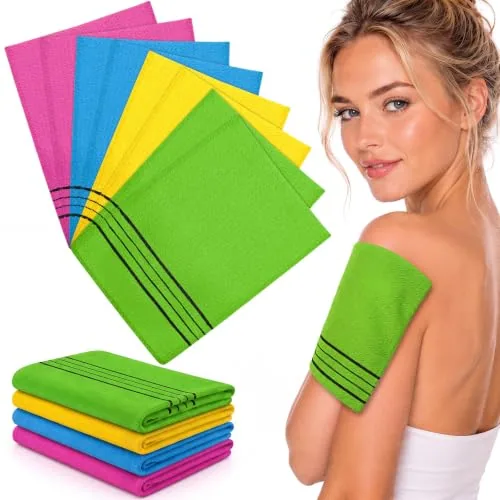
Our twelve pack breaks into four colors, three of each. That count is not an accident. A mitt wears out, and it wears out unevenly: the one that gets used for the legs goes first, then the one reserved for feet. Keeping spares of the same color matters less than keeping spares of a mitt you already know the feel of. Twelve covers about two months of regular use for one person, longer for the household that shares the chore across several showers.
The mitts themselves are 8 by 5.5 inches, a generous palm that lets the whole forearm make the stroke. We have settled on viscose as the fiber after years of trialling. It holds the scrub side of the weave stiff enough to do the work, and softens just enough with the first few uses that the skin does not notice the fabric the way it would a loofah. Color is the only choice on the page: dark tones for the shower caddy at the back, lighter tones for the hook by the bath. There is no size run beyond the one we make, because the mitt has one job and a bigger or smaller version does it less well.
We do not sell the exfoliating mitt singly, and we do not intend to. A single mitt is a half measure. It arrives, it is used, and the next one has to be ordered. A twelve pack is what fits how the thing actually gets through a household.
| Product | Size stated | In the pack | Per piece |
|---|---|---|---|
| 5-Piece Exfoliating Washcloth, Beige | not stated | 5 | $1.65 |
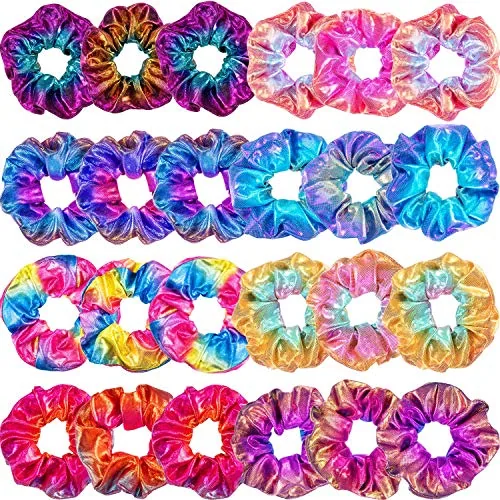
| 24-Piece Hair Scrunchies, Rainbow Colors | not stated | 24 | $0.38 |
| 12-Piece Korean Exfoliating Mitts, 8 x 5.5 in | 8 x 5.5 in | 12 | $0.67 |
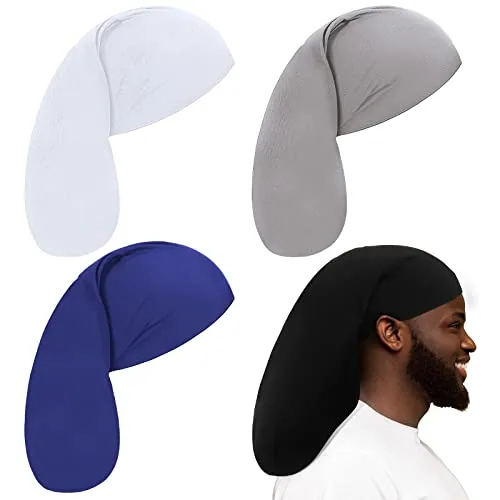
| 4-Piece Long Dreadlock Cap, 4 colors | not stated | 4 | $3.50 |
What a mitt will not do
We make our exfoliating mitts from viscose. What they do is friction on the outer layer of skin, moving dead cells that have already loosened. They do not penetrate, treat, or cure. Acne, keratosis pilaris, hyperpigmentation, thick calluses: each lives somewhere the mitt cannot reach, and a routine built on the mitt alone will not move them.
Acne is partly bacterial, partly follicular. A mitt scrubs the surface. It does not clean a clogged pore from inside, and it does not change the chemistry of a breakout. People with active, inflamed acne often find that vigorous rubbing makes the skin angrier and the marks last longer. If your back is broken out, the mitt is the wrong first move. Wash gently, treat the cause, and reach for the mitt later.
Keratosis pilaris is keratin plugging the follicle. The bumps are not flakes on the surface. They are plugs sitting inside the pore. Scrubbing around them does not dislodge them, and the redness that follows often looks like a setback. Standard advice is a leave-on product used daily. A mitt has no role here.
Pigmentation lives below the layer a mitt reaches. Sun spots, melasma, and marks left by old breakouts sit deeper than dead skin. The mitt can make surrounding skin look fresher, briefly sharpening the contrast with a darker spot. The spot itself is unchanged, and real change is slow and usually medical. Calluses build up over weeks. A mitt can ease a soft, recent one with steady sessions. A thick, structural callus on a heel will not shift in one bath or three. Anyone with diabetes or skin that breaks easily should not be using one at all.
The short version
A Korean exfoliating mitt is a thin, textured glove made from a viscose weave. It works by catching dead skin as you glide it across wet skin. In Korean bath houses, and more recently in homes here, the mitt is used for a single full-body pass in the tub. It is not a washcloth. It does not need soap, and treating it like one is where most of the trouble starts.
The method is short. Soak in warm water until the skin softens. Wet the mitt, squeeze it out, and draw it across the body in long, even strokes with the grain of the skin. Rinse the mitt often. When the skin turns pink, stop. The whole pass takes a few minutes, not a session.
Most damage we hear about comes from four habits: using the mitt on dry skin, scrubbing in circles, going back over the same patch to chase flakes, and using it too often. Soap inside the mitt clogs the weave and dulls the texture. A plain rinse is enough. After use, hang the mitt somewhere it can dry fully. A damp mitt is a short-lived mitt.
Our pack holds twelve mitts in the 8 by 5.5 inch size. That count is enough for a household to rotate through the week without a special trip when one starts to wear out. The mitt is a small, replaceable thing, and we sell it the way it gets used: by the count, not by the single piece.
More from the Tatuo journal
- Setting up a craft table when small parts are on it
Rhinestone tools, beads and kit pieces are small by design. What the federal small parts rule says, how to lay a table out, and how to keep a class busy. - Fabric bundles, faux fur and what a care label owes you
Fat quarters, ten-inch squares, fur by the strip and lace by the yard. What each cut is for, and what the Care Labeling Rule does and does not require.