How Tatuo works
How a Tatuo run gets decided, checked and packed, who does which part of it, and what we will and will not claim about ourselves.
How we work
Production, and how Tatuo got to be a brand about counting
We make household goods in production runs, not a continuous stream. In each run, we settle the material, measurement, and count before anything is packed. We check a sample against that decision before printing the packaging. If the run does not match the sample, it stops there.
Most of the things we use get used up. A washcloth thins. A label peels off. A drawstring bag goes home with a wedding guest and stays there. Buying them one at a time is the most expensive way to do it, and the way that sends you back to the shop the soonest. We started Tatuo around that observation. The pack is the unit. The single piece is what is left when the pack is gone.
A new line begins with a material. We pick the fiber or the board or the foam first, then ask for a small piece of it to live with for a week. The piece gets washed, folded, rubbed, opened and resealed. If the sample survives what we do to it, we order a production run from the same source. If it does not, we go back to the material step and start over. The sample is not a formality.
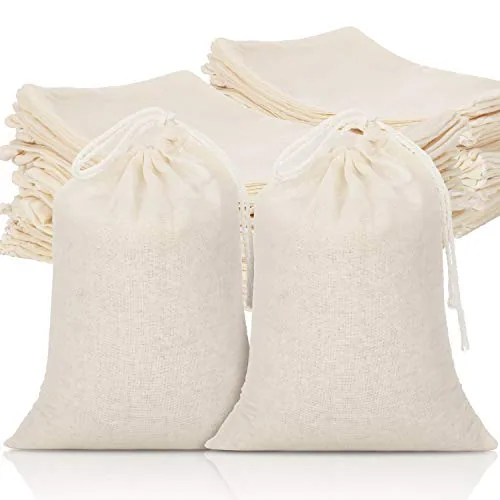
We count from the consumer end. Twelve exfoliating mitts is a year of weekly use with a few left for guests. Fifty muslin bags covers a market stall or a small wedding. Three hundred SIM tray pins covers a repair bench for a long time. Ten and one hundred sound tidier on a label, but they do not match how the thing actually leaves the pack. We pick the number that empties the bag at the right pace.
Packing matters because most of what we sell is used over time, not in one sitting. A bag that has to be torn open on day one cannot hold the rest of the mitts on day ninety. We choose closures that open and close without a tool, and we test them on the sample before we print the wrapper. A pack that fights you on the second use has already failed at the first.
We do not run our own warehouse, our own delivery, or our own checkout. The order is placed, paid for, shipped and returned through the retail partner that carries the range. That keeps our attention on the pack itself: the material, the count, the sample, the closure. Everything around the pack is someone else's job, and we try to make their job easier by sending out a product that does not need explaining.
The people
Who does what at Tatuo
We're a small team. The person who picks the cotton or the foam often opens the sample box too. After the sample comes the count, then the pack. Mail from that day usually lands on the same desk.
The ones who choose
The people who choose our materials keep a drawer of mitt samples in every weave, plus scraps of lace and tape squares pinned to a board. They trust what feels right in the hand over what looks good in a photo. A swatch that photographs well and feels wrong goes back.
The ones who check
A few of us handle every run. We open the cartons first, count packs against the order, measure to the printed size, and pull a piece from the bottom of the stack rather than the top. If a run does not hold up to that, it does not move on.
The ones who answer
The people who answer our letters read every complaint twice. A mitt that fell apart on first use, a pack of twelve that should have been twenty, a care line we wrote too quickly. They pass the pattern back, and the next run ships with the change.
We don't put names, headcounts, or a street address on this page. Those are the details a brand page invents first, and we'd rather not start. The work shows up in the count on the pack and the material on the label. That is the introduction we'd rather make.
- No names, because a name on a brand page is the easiest thing in the world to invent.
- No headcount, for the same reason.
- No address, no founding date, no certificate wall.
Quality
How we judge a Tatuo run
Quality, for us, is whether the fifteenth piece in a pack is the equal of the first. We pull a sample from every production run, and we print the packaging only after that sample passes. A run that does not match the sample does not go out.
Before we print packaging for a run, we pull our sample from the bottom of the carton. The top of a pack is what gets shown in a photo and handled first in a shop, so it tends to look the part. The bottom is where a thin spot, a careless cut, or a color drift shows up. We work from that piece, not the one on top.
Count is the easiest thing to get wrong quietly. A filling line that runs one short on the first pack keeps running one short on every pack after it, and nobody notices until they open the last one in the carton. We count the sample by hand against what the label says. If the numbers don't match, the run doesn't go out.
Every measurement on a label comes from a rule laid against the piece itself, not from the drawing we started with. Drawings are useful but they drift: corner roundings, fold allowances, a tolerance that's fine for one project and not for another. If the rule and the piece disagree by more than a small margin, the packaging doesn't print and we send the question back.
What we check before a run ships
- The count. A pack of fifty holds fifty, and we open packs to prove it rather than trusting the filling line.
- The last piece. We look at the piece at the bottom of the pack, because that is the one nobody photographs.
- The stated size against the made size, with a rule, on the piece itself.
- Color against the approved sample, in daylight, not under the bench lamp.
- Edges and seams: overlocking on cloth, burrs on steel, glue squeeze on tape.
- The pack itself, opened the way a customer opens it.
Certification
What we can show you, and what we cannot
We do not put a badge on this page that we have not earned. What we can show you is what our own packs state, and the public rules the categories sit under. Where a pack names a fiber or a material, we print that. Where it names nothing, we leave the line empty rather than filling it with a shield.
There is no certificate that covers a drawstring bag, a length of lace trim, or a washcloth. A brand that posts one for any of these is posting a graphic, not a document. What does exist is public rules for particular categories. Where a category is regulated we point at the rule. We do not put a mark on a product that we have not earned the right to use.
Where a pack states a material on its label we print that material as a statement from the pack. Where the pack states nothing about material we say nothing. The same goes for measurements, counts, and care. We work from what is on the package, in the language the package uses, and we do not round a fabric up to a fiber or a finish we cannot see.
The public rules our categories fall under
- Craft kits and small pieces. The small parts ban is codified at 16 C.F.R. part 1501. It sets what counts as a small part and when a choking hazard label is required.
- Fabric, trim and piece goods. The Care Labeling Rule at 16 C.F.R. part 423 governs care instructions on clothing and on piece goods sold for making apparel at home.
- Skin contact. There is no federal certificate for a washcloth. What exists is published dermatological guidance, which we quote rather than paraphrase.
Links and reading dates are on our sources page.
What we make
Eight Tatuo lines, and what sits in each
Bath & Body
We pack exfoliating mitts, Korean scrub towels and washcloths in counts that let a household swap one out without a special trip. Sixty-eight products in the line, in viscose and nylon.
68 products in this line, 4 shown above.
Bags & Pouches
We make cotton, muslin and burlap drawstring bags from three inches up, packed in the counts a market stall or a wedding actually gets through.
37 products in this line, 2 shown above.
Fabric & Sewing
Faux fur by the panel, cotton bundles, wax print fat quarters and lace trim, all cut to project sizes rather than full bolts. Home sewers, quilters and small craft sellers buy them by the pack.
206 products in this line, 4 shown above.
Craft & Party
Craft kits, rhinestone tools, banners and party pieces, with pack counts that cover a class or a party table in one order. Teachers and party hosts come to us for the right count.
269 products in this line, 1 shown above.
Tape & Fixings
We count out double sided foam tape, o-rings, hooks and the other small fixings that hold a job together once the tools are put away. Sixty-five products in the line, sized for a household drawer or a workbench.
65 products in this line, 2 shown above.
Tools & Gadgets
We make a 39-piece line of tools and gadgets: reachers, inspection mirrors, eject pins, tweezers and cord boxes for the jobs that need one proper piece. Workshops, repair benches and tidy drawers count on them.
39 products in this line, 3 shown above.
Home & Everyday
Our largest line: the napkins, labels, growth charts and liners a household reorders when the last one runs out, sold in the counts a home actually gets through.
633 products in this line, 4 shown above.
Packing & Shipping
We make mailers, corrugated boxes, card sleeves and inserts for people who post what they make or sell, in packs sized to one shipment instead of a pallet.
19 products in this line.